

An old crop, a new leaf
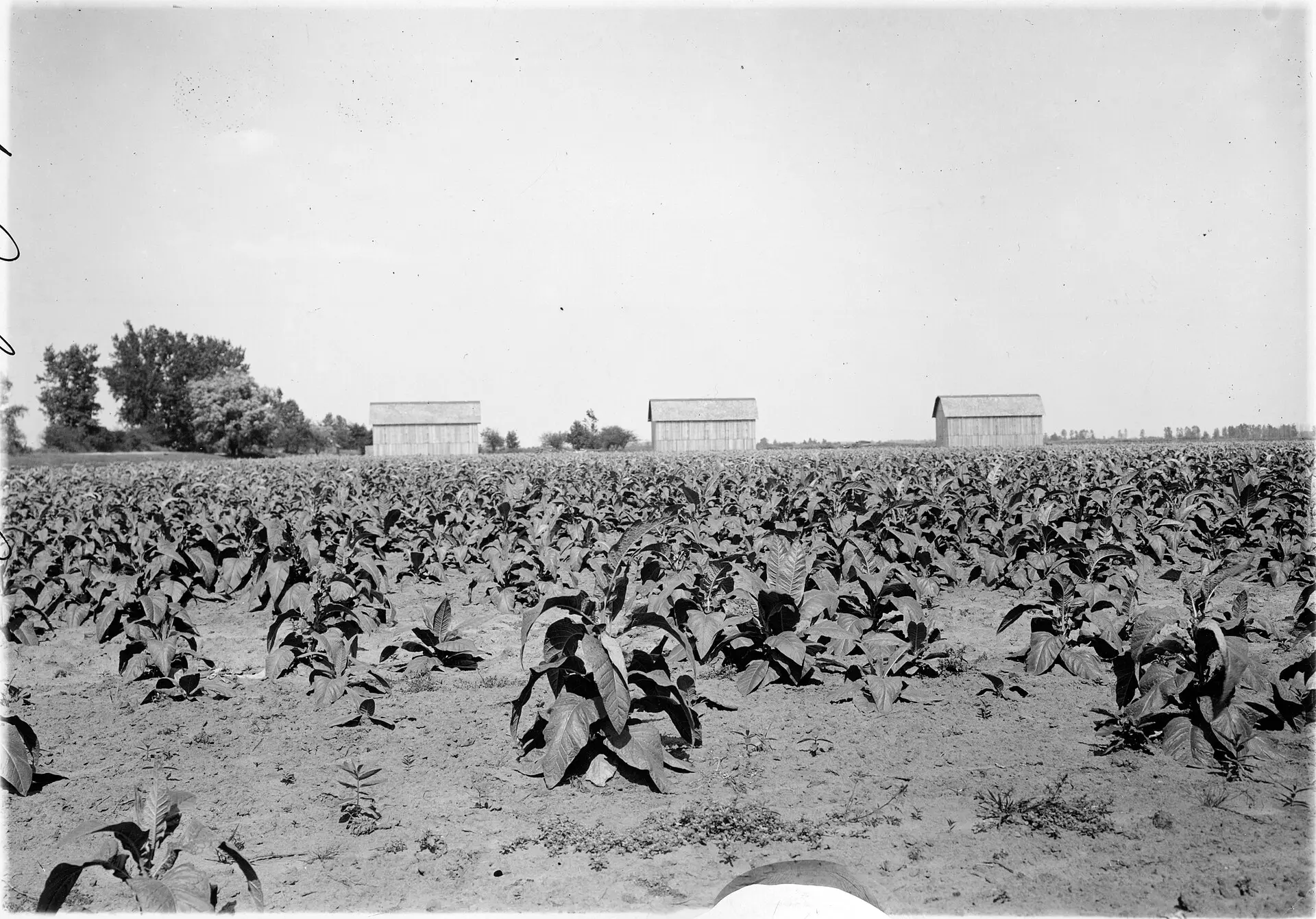
Tobacco was not new to Ontario when Norfolk’s farmers took it up. Burley, an air-cured leaf, had been grown in the far southwest of the province for more than a century before 1909.1 tobacco came later. The first crop was grown in extreme southwestern Ontario in 1910, and the first commercial crops followed in 1913.1
For a decade it stayed a minor crop. By 1924 Ontario grew less than 2,830 hectares of flue-cured tobacco, against about 8,100 hectares of burley and other air-cured types.1 What changed the balance was the cigarette. As demand for cigarettes grew after the First World War, so did demand for the light flue-cured leaf, and growers went looking for land that could produce it.1
Flue-cured was still the small crop
Within a decade the balance would flip, and the growth would happen on new ground.
The inspector from the South
Henry A. Freeman came north from South Carolina and became the federal tobacco inspector for Ontario, working closely with the experimental station at Harrow in Essex County.2 In October 1920 he and D. D. Digges published Flue-cured Tobacco in Canada, a 44-page bulletin with growing instructions, a survey of tobacco soils and a series of fertilizer experiments.2
The station’s history describes a man who had visited every tobacco district in the province and was “an exceptionally capable judge” of which soils and weather suited the crop.2 In 1921 he and William L. Pelton, another American, from Wisconsin, grew 21 acres of flue-cured tobacco in the Leamington area, in the heart of the old belt.2
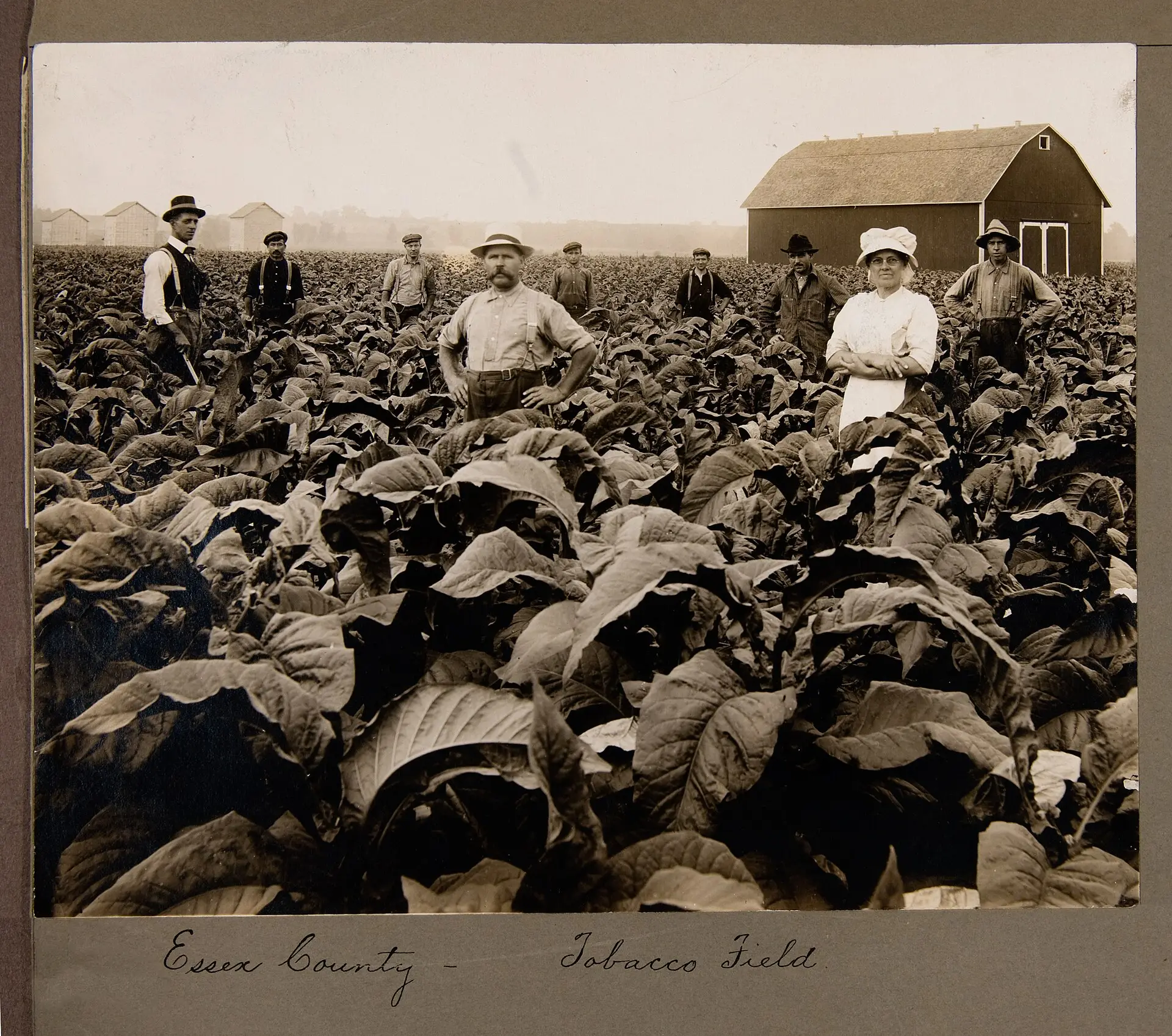
Essex and Kent grew Ontario’s early tobacco. Within a decade of Freeman and Pelton’s move, the centre of flue-cured growing had shifted to the Norfolk sand plain.
Five acres at Lynedoch
The next year they looked east, to the light, sandy soils of Norfolk County. In 1922 Freeman and Pelton grew an experimental crop of five acres near Lynedoch, a hamlet southwest of Delhi.2
It worked. In 1923 they bought the old Chrysler farm at Lynedoch and harvested a commercial crop of 30 acres, which the federal history calls the first in what came to be known as the .2 The Multicultural History Society of Ontario has featured a kiln built that same year on their experimental farm at Lynedoch.3
Was Lynedoch really the first?
Agriculture Canada’s Harrow history credits the 1923 Lynedoch crop as the first commercial flue-cured crop of the new belt.2
Jonathan McQuarrie calls the exact origins of Norfolk’s flue-cured tobacco “debatable,” while noting that several sources credit Freeman and Pelton’s 1923 plantation as the first.4
Accounts also disagree on where the two men came from. The Harrow history has Freeman from South Carolina and Pelton from Wisconsin; an MHSO report calls them North Carolinians.23 We follow the federal account and say so.
 Today
TodayThe new belt takes hold
Once the sand plain had shown what it could do, development came quickly. Experienced growers from the United States demonstrated its suitability in the mid-1920s. In the late 1920s, soil studies by Professors Gerald Ruhnke and Frank Morwick of the Ontario Agricultural College, and the first soil map of the area, gave growers a clearer picture of the land.1
Freeman himself went all in. After two years as superintendent at Harrow, he resigned in January 1928 to become the owner of Ontario Tobacco Plantations in Norfolk County.2 Early flue-cured growing in Norfolk was closely tied to plantations like his, run on a system of shares with managers and tenant farmers, and to the interest of the Imperial Tobacco Company and its buyer, Francis Gregory.4
“Tobacco has blossomed like the rose in the desert”
By 1931, Norfolk’s flue-cured production had overtaken the total tobacco production of Essex and Kent, the counties of the old belt.4 Two years later, the federal government would open a research substation on 20 hectares just west of Delhi, to study the new crop on its new soil.1 That story is chapter 4.