

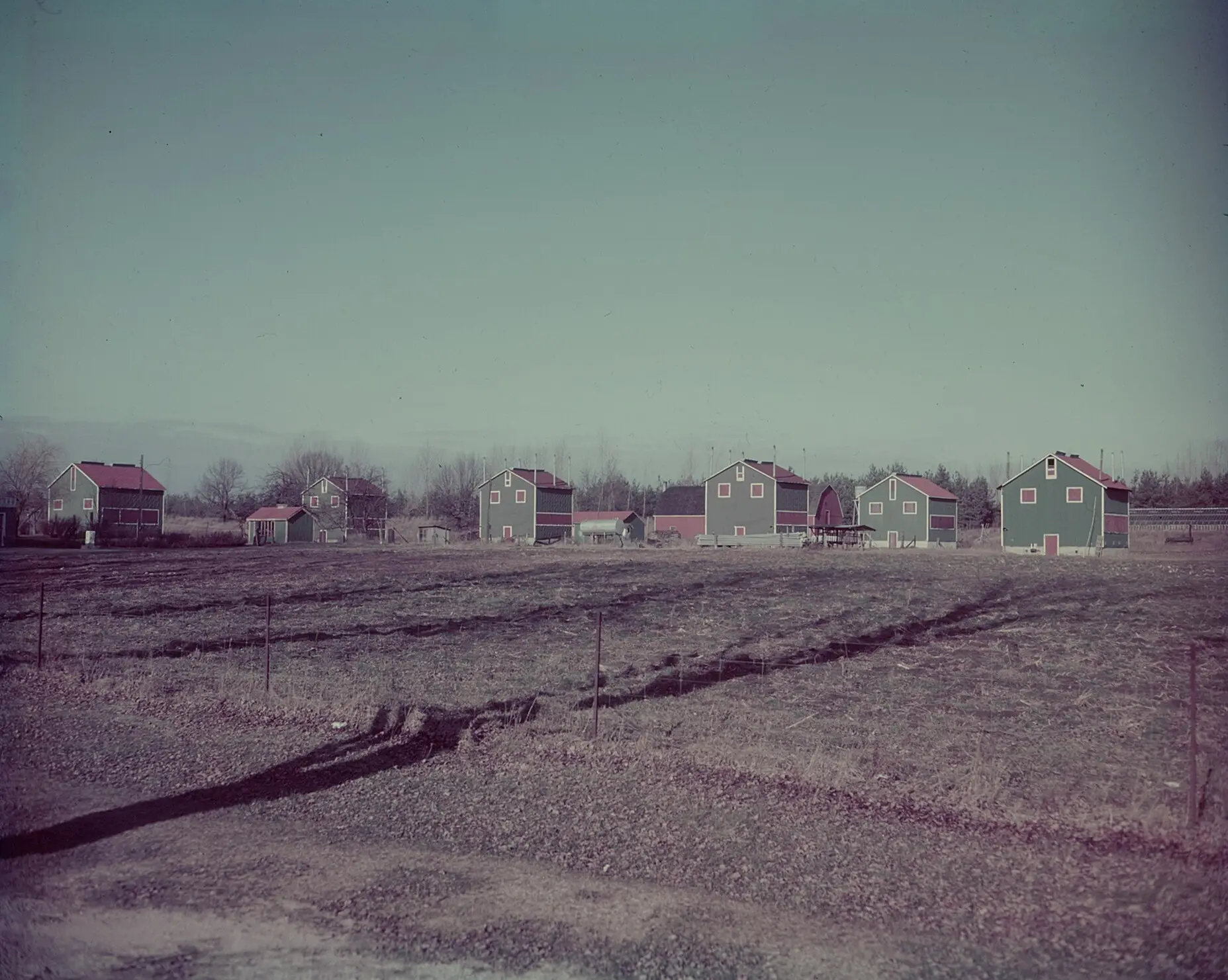
1856–2009 The tobacco years
From the naming of the town to the last auction at the Delhi exchange. Filter by theme or community, and tap any source number to see where a date comes from.
- 1856
Delhi gets its name
Popular histories of the town say the settlement once known as Sovereen’s Corners, then Fredericksburg, took the name Delhi in 1856.S36
- 1874
The Quance mills open
The Quance family’s mills open on Big Creek. They run until 1970.S33
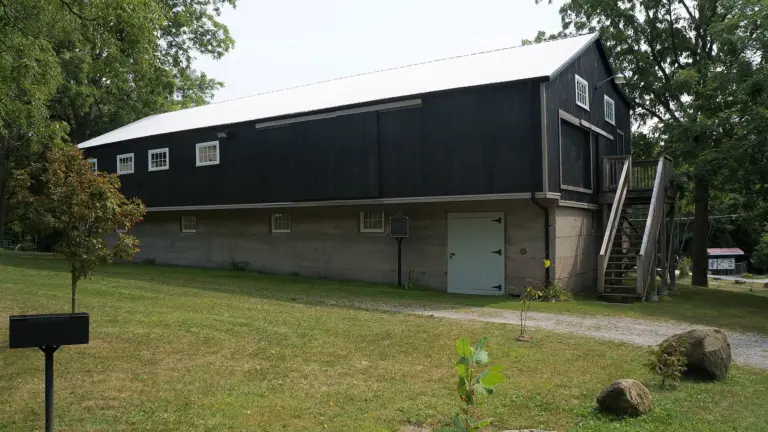
The Quance Saw Mill, Quance Park, 2017 · Jfvoll - 1893
Delhi incorporated
Popular histories of the town give 1893 as the year Delhi was incorporated as a village.S36
- 1910
Flue-cured arrives in Ontario
The first flue-cured tobacco is grown in extreme southwestern Ontario.S1
- 1913
First commercial crops
The first commercial flue-cured crops are grown in southwestern Ontario.S1
- 1920
A bulletin on flue-cured
D. D. Digges and Henry Freeman publish Flue-cured Tobacco in Canada, a 44-page bulletin on growing the crop.S2
- 1921
21 acres at Leamington
Freeman and William Pelton grow 21 acres of flue-cured tobacco near Leamington, in the old belt.S2
- 1922
A trial at Lynedoch
Freeman and Pelton grow an experimental five acres near Lynedoch, southwest of Delhi.S2
- 1923
The new belt begins
They buy the old Chrysler farm at Lynedoch and harvest a 30-acre commercial crop, which the federal history calls the first of the new belt.S2
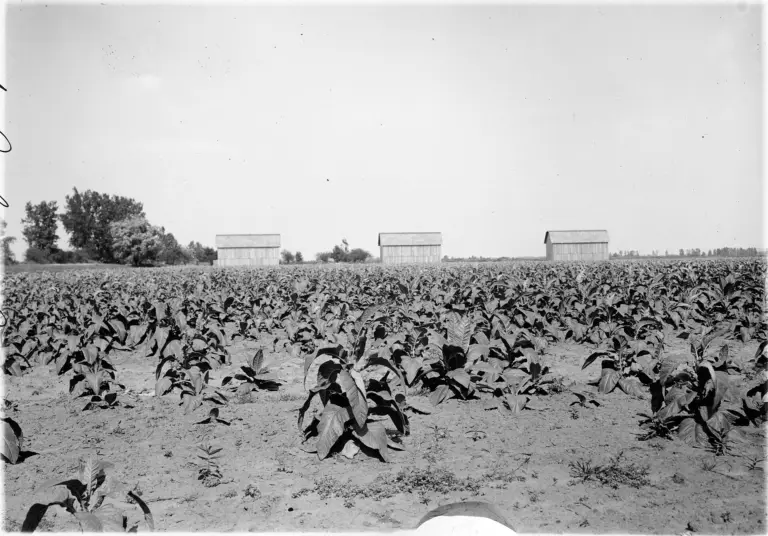
Tobacco and curing barns, Ca. 1920 · Archives of Ontario, I0004344 - 1928
Freeman goes all in
Freeman resigns as superintendent at Harrow to become owner of Ontario Tobacco Plantations in Norfolk County.S2
- 1930–31
Lithuanian families arrive
Lithuanian families are working Delhi-area tobacco farms by 1930–31, the community’s history says, and number about 100 by the Second World War.S29
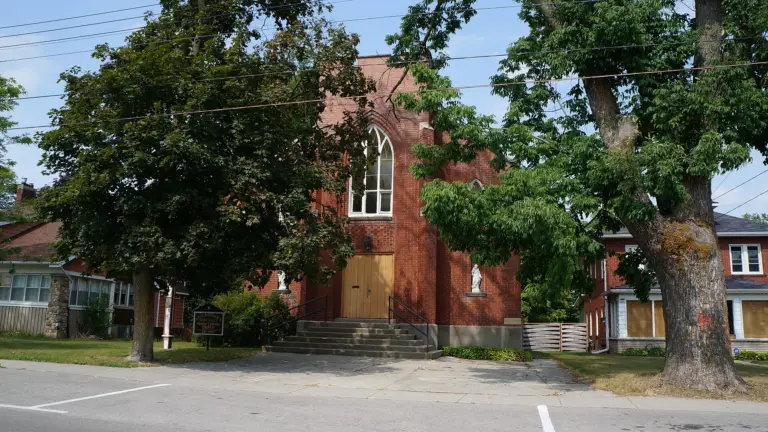
St. Casimir Lithuanian Roman Catholic Church, 2017 · Jfvoll - 1930s
Lumber for the kilns
The Quance mills cut lumber for tobacco kilns, laths and barns.S33
- 1931
Norfolk takes the lead
Norfolk’s flue-cured production overtakes the total tobacco production of Essex and Kent.S3
- 1933
Science comes to Delhi
A federal tobacco research substation opens on 20 hectares about 4 km west of Delhi.S1
- 1933
Sand and frost
About 1,210 hectares of seedlings are lost to blowing sand, and 200 hectares to a frost on 14 June.S1
- 1936
A German association forms
The German association that will build the German Home is formed on 20 April.S24
- 1938
The station is bought
The government buys the substation land, with an adjoining 20 hectares.S1
- 1943
A Belgian drama club
Delhi’s Belgian community forms a dramatic club, the start of the Belgian Club.S9
- 1943–45
The wartime harvest
Permits are needed to work on a tobacco farm, and army units help bring in the crop.S1
- 1948
The Belgian hall opens
The Belgian Club opens its hall.S9
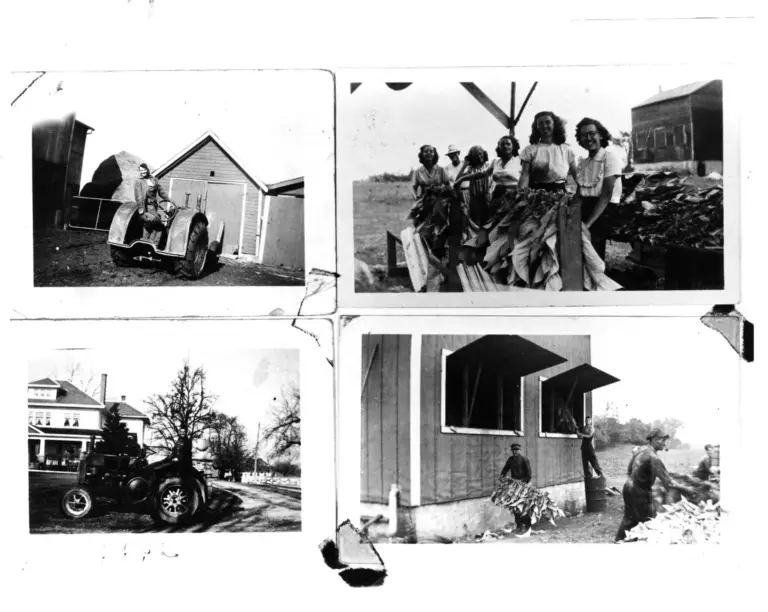
Belgian Canadian collection – tobacco farming and Mrs. Van Compern, 1928–1929 · MHSO fonds, Archives of Ontario, I0057364 - 1949
The Hungarian House opens
Delhi’s Hungarian community opens its hall on 15 May 1949.S8
- 1950
The German Home opens
Built in 1949, the German Home opens in November 1950.S24
- 1951
A Hungarian church
The Calvin Presbyterian Church begins serving Delhi’s Hungarian community. It does so until 2017, the museum’s Building History series records.S42
- 1953
Irrigation research
The Delhi station begins an irrigation research programme. A storage pond follows in 1956.S1
- 1956
A Tobacco Queen
The Hungarian Hall’s annual Tobacco Festival crowns a Tobacco Queen in October, and the Delhi News-Record puts her on the front page.S39
- 1957
The marketing board
Growers form a marketing board, with quota and auction exchanges at Delhi, Tillsonburg and Aylmer.S10
- 1959
- 1961
Canada’s first bulk kiln
The Delhi station buys a bulk-curing kiln from the United States to test, the first in Canada.S1
- 1966
Seasonal workers
Canada’s Seasonal Agricultural Worker Program begins, with Jamaica.S18
- 1966
“Delhi’s camp misery”
A Toronto Star photo shows harvest workers keeping warm by a fire at a Delhi camp, on 3 August.S32
- 1967
Peak acreage
Ontario plants 128,000 acres of flue-cured tobacco, up from 30,000 in 1933.S4
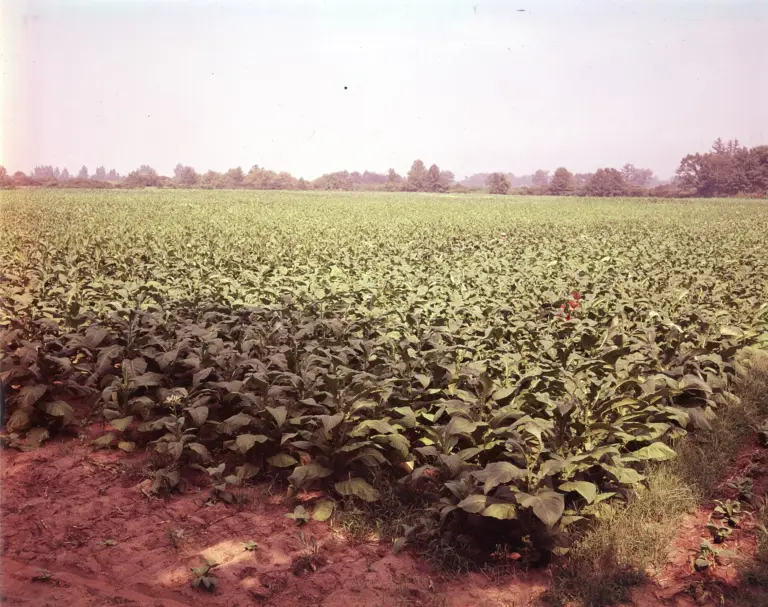
Tobacco field in Long Point, 1952 · Archives of Ontario, I0015246 - 1975
- 1977–88
The voices recorded
The Delhi Tobacco Project records 308 cassettes of oral history, about 267 hours, in six languages.S5
- 1979
A museum in a pack barn
A museum built in the form of a typical tobacco pack barn goes up above Quance Park in Delhi.S6
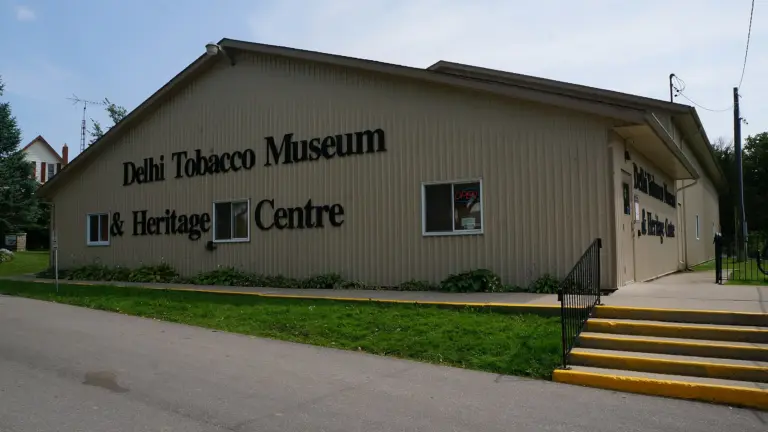
Delhi Tobacco Museum & Heritage Centre, 2017 · Jfvoll - 1981
New crops
After peanut research ends in 1980, the station begins a new crops programme.S1
- 1988
The long decline
Production has fallen nearly 50% since 1982, and growers from 2,500 to 1,500, Norfolk’s MPP tells the Legislature.S12
- 1997
The Tobacco Act
Parliament passes the Tobacco Act, renamed the Tobacco and Vaping Products Act in 2018.S16
- 2008
- 2009
The last auction
The Delhi exchange closes as the quota system ends.S11
- 2013
No events match those filters yet.