

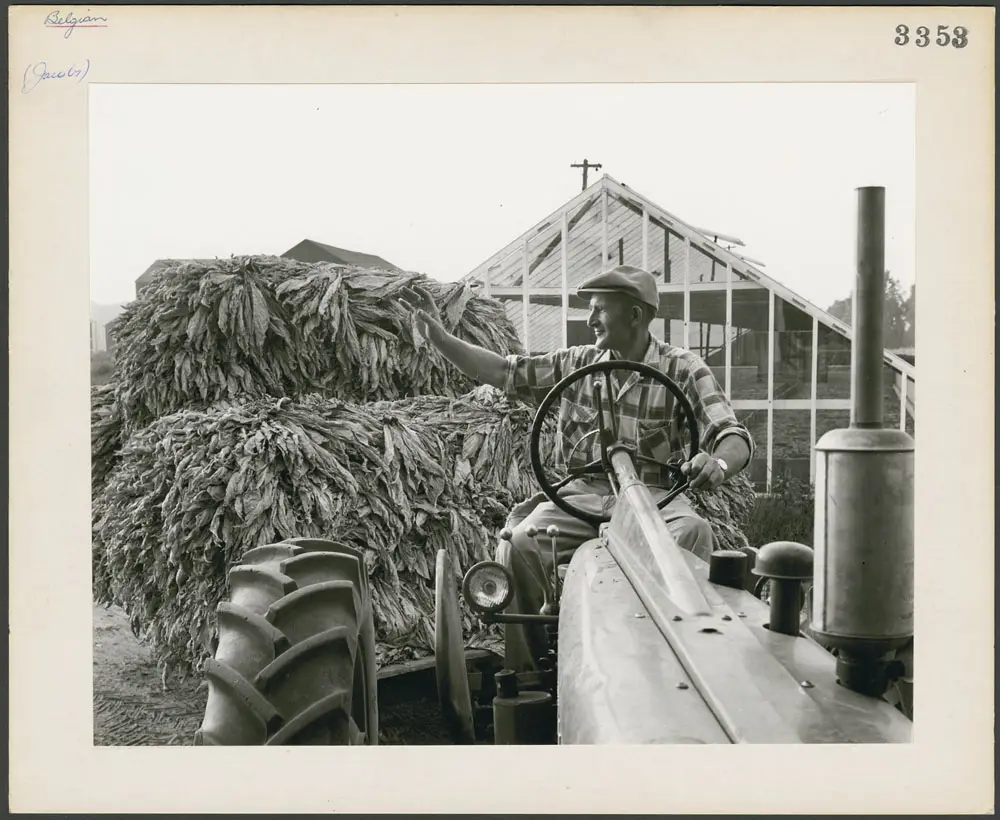
Was there a peak?
There is no official peak year. But the 1950s to the 1970s are fair to call the era when tobacco dominated Delhi most visibly: the marketing board and the exchanges, irrigation and machines, the research station’s growth, the halls and the seasonal workers all belong to it.
By the numbers
Agriculture Canada’s 1973 profile of the Delhi station gives the clearest measure of scale.1
More than four times the acreage
Yields rose too, from 897 lb an acre in 1933 to 2,483 lb an acre by 1971.1
The same report put the crop’s average value over the previous five years at about $138 million, and said about 70 percent of Ontario’s crop grew within 20 miles of the Delhi station.1 These are Agriculture Canada’s figures from the time.
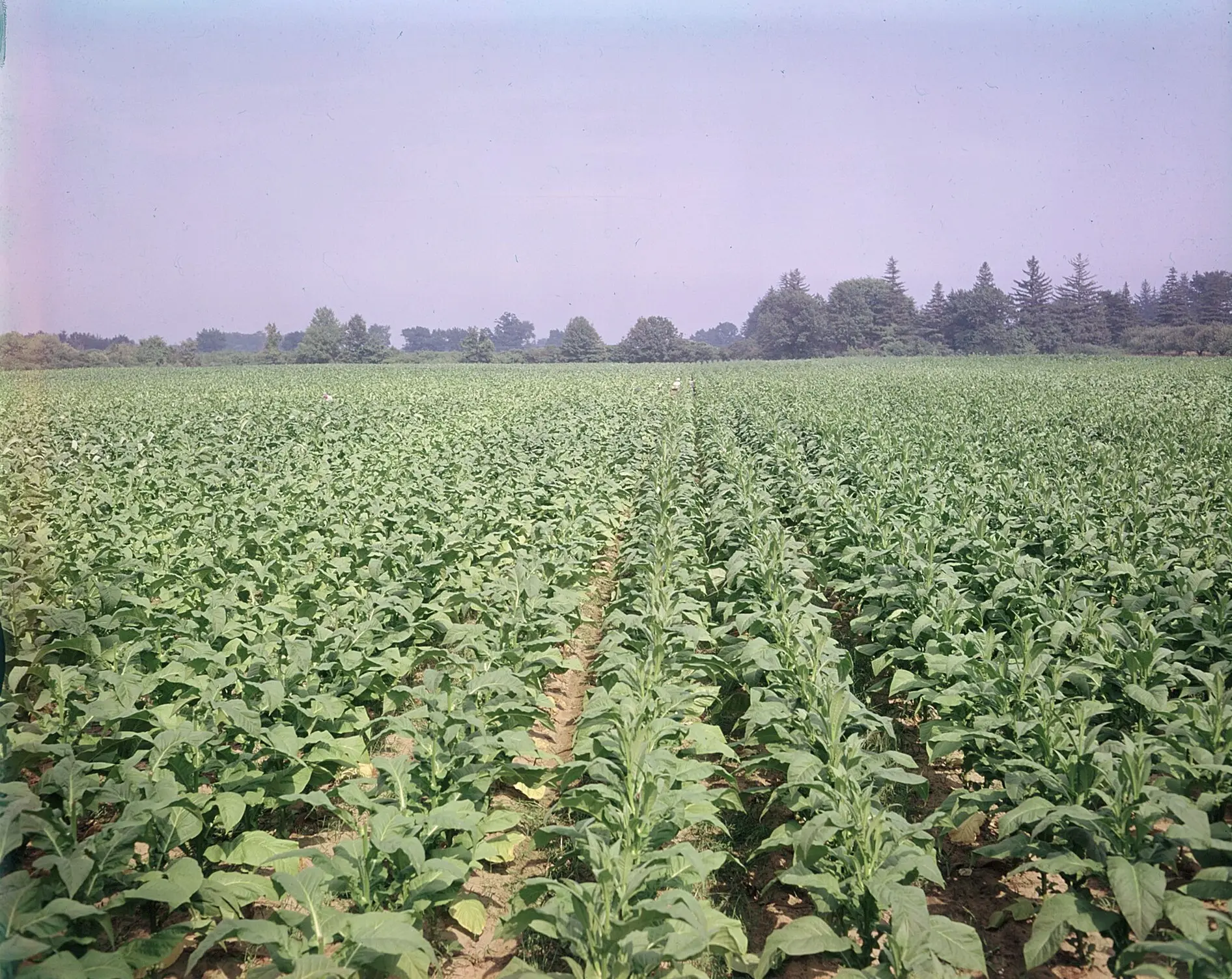
Beyond the farm
Tobacco kept far more people busy than growers: equipment dealers, fertilizer and irrigation suppliers, kiln builders, truckers, processors, auction staff, repair shops, seasonal housing and food, banks and shops. So a downturn hit the whole town. When the Dibcom tobacco processing plant in Delhi shut down in 1988, Norfolk’s MPP told the Legislature it had cost 25 full-time and 200 seasonal jobs in a town of 4,500.2
The halls
Delhi’s halls belong to the same years: the Belgian Club’s hall of 1948, the Hungarian House of 1949 and the German Home of 1950.345 Chapter 8 tells their stories.
Crowning the crop
On a Friday night in October 1956 the Hungarian Hall held its annual Tobacco Festival and crowned a Tobacco Queen: a 16-year-old who lived and worked on her parents’ tobacco farm near Tillsonburg. The Delhi News-Record put the crowning on its front page. Among her prizes, the paper reported, was a trophy the Imperial Tobacco Company donated each year, and the organizers planned to make the festival an annual event.6
The Hungarian House went on to help run something bigger. Its own history names it a major organizer of the Delhi Harvest Festival from 1971.3 The festival had a queen of its own. A newspaper clipping headed “New Harvest Festival Queen Crowned” reports that Barb Hill, 21, of Delhi was crowned Delhi Harvest Queen at the opening ceremonies, between the outgoing queen, Dianne Van Parys, and the reigning Miss Canada, Terry Lynne Meyer.7 The clipping carries no date, but Meyer was chosen Miss Canada in October 1974, which puts the crowning at the festival of September 1975.8
By the 1980s the crown was the Ontario Tobacco Queen’s. The Delhi News-Record gave a page to the 1988 contestants, led by the reigning Miss Ontario Tobacco Queen of 1987, Lianne Trembley, 19, of Langton, and display cards shared with the Delhi Tobacco Museum’s partners name the queens of 1983–84, Leisha Decarolis (Reynaert); 1991–92, Bridgette Soenen; and 1997–98, Michelle Braun.7 The two-year titles suggest each queen was crowned at harvest time and reigned until the next.
Photos wantedThe Harvest Festival and its queensCrownings, floats, the tying contest, the midway: any year. And if you know who wore the crown in a year we haven’t listed, tell us.Share a photo →