

The marketing board
In 1957 the Ontario Flue-Cured Tobacco Growers’ Marketing Board was set up under Ontario’s Farm Products Marketing Act, replacing a growers’ association the Elgin County Archives calls “troublesome.” The board negotiated with buyers over demand and prices, controlled production through quota, and ran the auctions.1
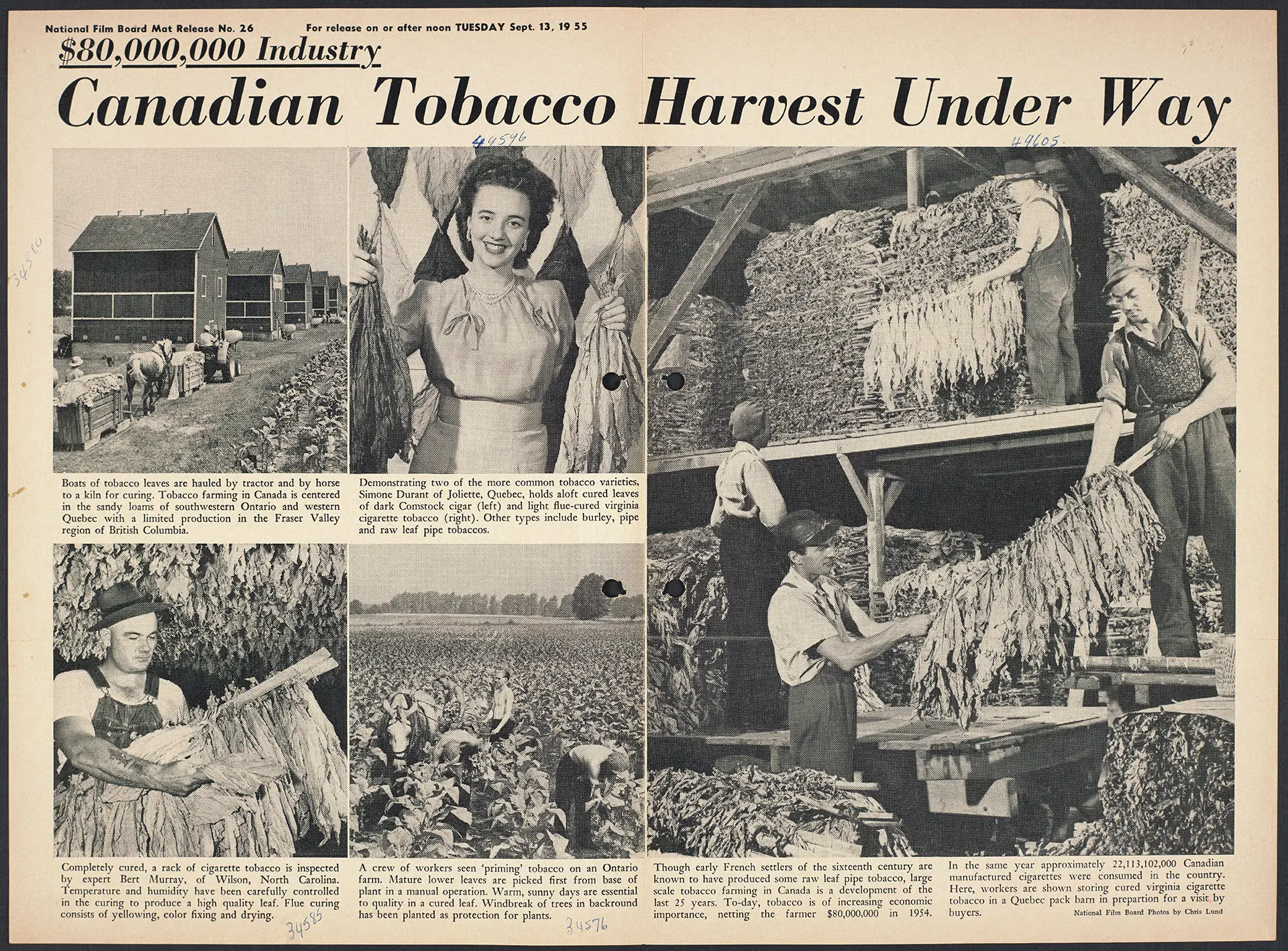
The board began with one representative from each of fourteen district committees.1 It replaced an association that had been setting the terms for years. A 1955 newspaper account from the Durham region reports that the Ontario Flue-Cured Tobacco Marketing Association had set a minimum average price of 43¼ cents a pound for that year’s crop and cut its members’ acreage by a third, with buyers from the cigarette manufacturers bidding above the minimum on quality.2
The association had a history of its own. A first marketing board was formed in 1934 and brought farmers and buyers, Imperial Tobacco among them, together to negotiate an average minimum price for the crop. When the federal Natural Products Marketing Act it had been formed under was struck down by the courts, it reorganized as the Flue-Cured Tobacco Marketing Association of Ontario, which carried on much the same work, the historian Jonathan McQuarrie writes, drawing on Lyal Tait’s 1967 history.3 It handed out acreage allowances, and critics said it favoured large, well-capitalized growers.3
1937: good crops, poor prices
In the fall of 1937 growers and workers took on the price together. When it became clear that growers would be offered 23 to 26 cents a pound instead of the 35 to 40 they expected, about 250 of them met in Delhi on 15 September; the meeting’s chair, a Hungarian named only as Nerky, and its main speaker, Carl Hichin, were tobacco workers, and the meeting demanded 40 to 45 cents.4 In late October the association set the price at 24.5 cents. On 3 November about 1,200 people crowded a meeting in Simcoe, led by E. Holwell of the United Farmers of Ontario, with speeches in English, Hungarian and Flemish.4
It did not last. Soon after a stormy meeting on 10 November, growers were offered slightly more and began selling; by 13 November only ten crops remained unsold, and many of the hold-outs got one to six cents a pound more than the first offer.4 It was, Dunsworth writes, the biggest clash in the tobacco belt to that point. The price was what growers were paid for their crop, not what workers were paid for their days, but the two were tied: low prices meant low wages.4
Quota
Quota was known as , or BMA. To keep the crop from swamping the market, the board limited each grower to a percentage of their quota, set by expected demand.1 In 1960 it stopped issuing new quota, which made the quota farms already held more and more valuable.1
Once quota was scarce it had a price of its own, and some farmers sold theirs and left the industry.1 From 1978, when it was measured in pounds, quota could also be rented to other growers.1
The system changed over the years. BMA became Basic Production Quota in 1974, measured in pounds rather than acres from 1978, and was replaced in 2009 by licences and contracts with buyers.1
Three exchanges
The board ran three auction exchanges, at Delhi, Tillsonburg and Aylmer.1
Tobacco was sold on a , in a separate soundproofed room. The price ticked down until a buyer pressed a button to bid. The grower then had half an hour to inspect the tobacco and accept or reject the bid. A grower who turned down a second bid had to take the tobacco home until the next shipment.5
A day on the floor
Sales usually began in November, after the harvest.5 The Elgin County Archives describe how a lot moved through an exchange:5
- bales went to the warehouse, and samples were pulled for the buyers to inspect;
- each pallet was weighed and given a weigh ticket, and the farm number was removed before the sale, so the grower stayed anonymous;
- licensed graders hired by the board graded each pallet, and government graders checked the grading;
- the clock started well above the grade’s value and dropped a quarter cent at a time, and the buyer’s button recorded both the price and the buyer’s number;
- an accepted sale was recorded by the board, and the grower’s cheque went out the next day, less a small fee per pound.
Growers used their right to say no. After a post-Christmas slump in January 1966, growers at the Aylmer exchange rejected more than half of the buyers’ offers.5 Our page on the Delhi exchange has more.
Growers at the table
The board was run by growers. David MacLaren, a share grower near St. Williams who wrote the “Tobacco Forum” column in the Delhi News Record from 1954, sat on it as a share-grower director from 1959 to 1961.6 Andy Zei, a Hungarian-born grower who planted his first crop in 1951, spent forty years on it as committeeman and director, negotiating the annual crop price with the tobacco companies and joining trade missions abroad, one of which brought a contract to ship 10 million pounds of tobacco to Egypt, according to Norfolk’s Agricultural Hall of Fame.7
Photo wantedThe Delhi auction exchangeSale days, the clock, buyers and growers on the floor, in any decade. We don’t yet have a photo we can share.Share a photo →Closing time
The exchanges closed one by one: Aylmer in the fall of 1986, Tillsonburg in 2007, and Delhi, the last, in 2009, when the quota system was abolished.5
Closing Aylmer saved the board $250,000 a year in operating costs, as poundage fell.5 Chapter 14 tells what was behind the decline, and chapter 15 how the system ended.