

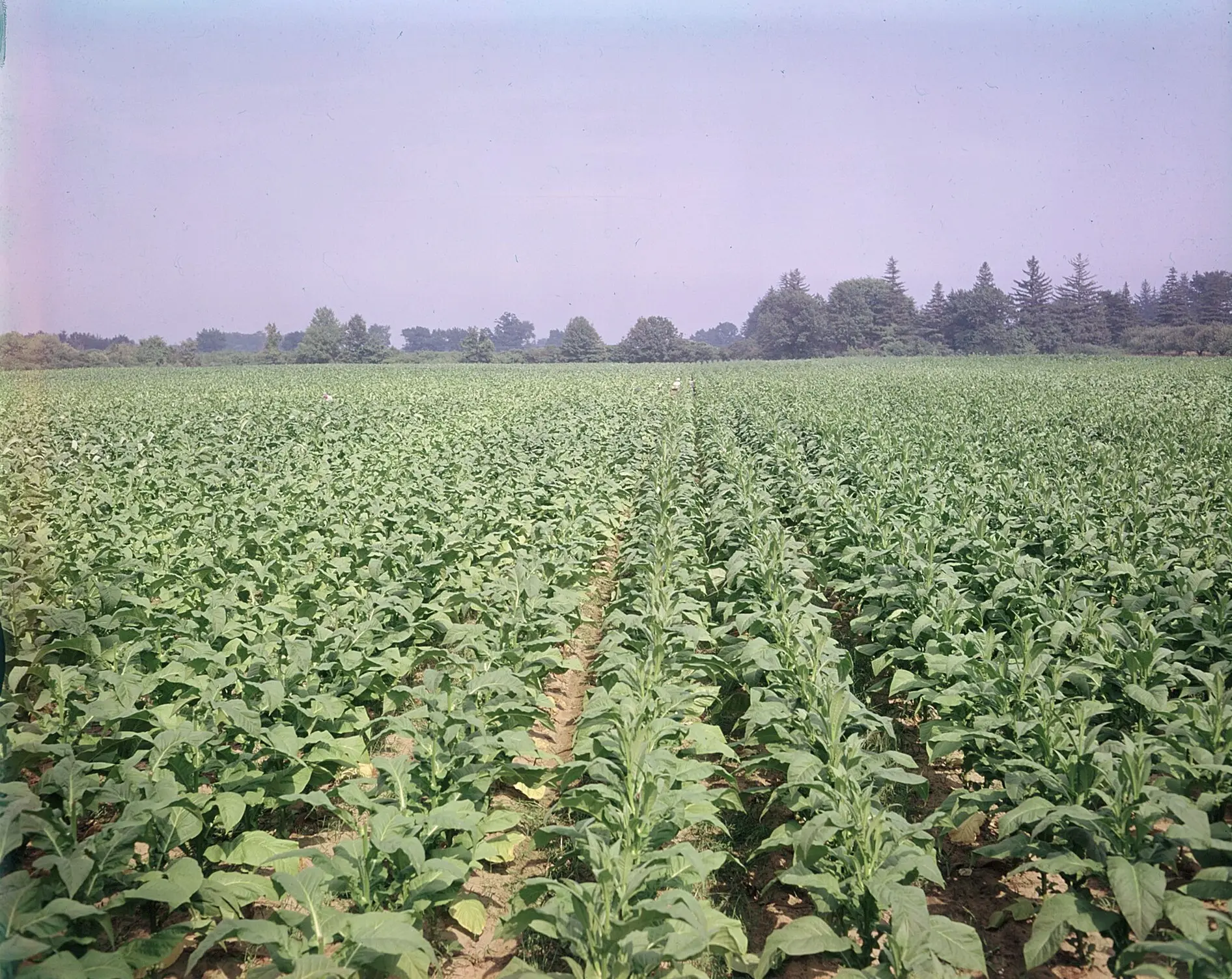
The tobacco harvest on film The Back-Breaking Leaf
In the late 1950s a National Film Board crew filmed the tobacco harvest around Delhi. The half-hour documentary is still one of the best ways to see what the work was like. Watch it here, and read what it shows.
The harvest, in 29 minutes
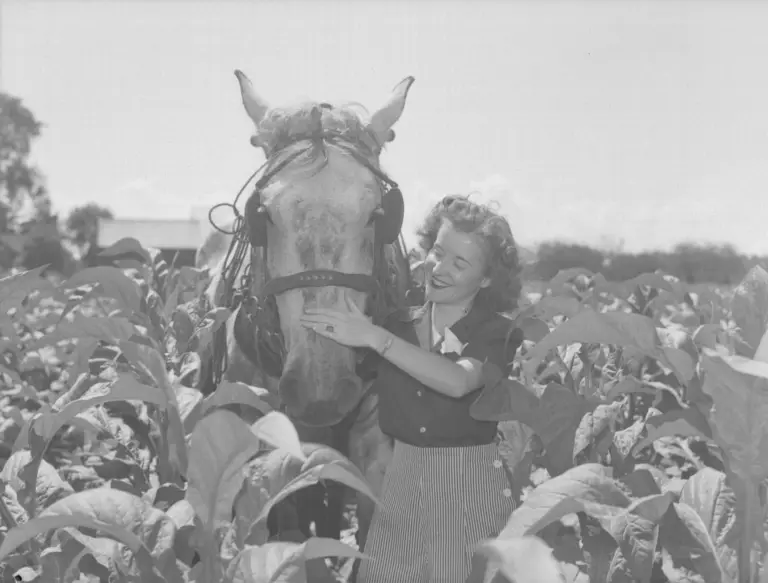
The film plays from nfb.ca, and nothing loads from there until you press play.S31 Still: a girl in a tobacco field, about 1945, Archives of Ontario.
The National Film Board calls it “a graphic picture of the tobacco harvest in southwestern Ontario”: the transient field workers who arrive at the end of July, when the plant is ripe, and the leaf that harvesters themselves called “the back-breaking leaf”.S31
The NFB’s own blog, which published stills from the film in 2016, places the shoot in Delhi in the late 1950s and describes a film about young and old workers and the farmers who depended on them, in a harvest that was punishing and could not wait.S30
- Director and camera
- Terence Macartney-FilgateS31
- Producers
- Roman Kroitor, Wolf KoenigS31
- Executive producer
- Tom DalyS31
- Editing
- John SpottonS31
- Music
- Eldon RathburnS31
- Commentary
- Stanley JacksonS31
- Sound
- Terence Macartney-Filgate, Victor Merrill, George CrollS31
- Assistant director
- Gilles GasconS31
- Running time
- 29 minutesS31
- Released
- 1959In the NFB’s Candid Eye seriesS30
Southwestern Ontario, or Delhi?
Where was it shot?
Describes the film only as a picture of the tobacco harvest in southwestern Ontario.S31
Its 2016 post on the film’s stills places the harvest in Delhi, Ontario, in the late 1950s.S30
The two don’t conflict: Delhi is in southwestern Ontario. We follow the blog, which is more specific, and would welcome anyone who can name the farm.
Nobody on screen is credited. When readers asked the NFB whether their grandparents appear in the film, the Board replied that the people in it weren’t named, so it couldn’t say.S30 Other families on the same page wrote that a grandmother, a father, a mother or an uncle are in the photos or the film.S30
The gang, field to kiln
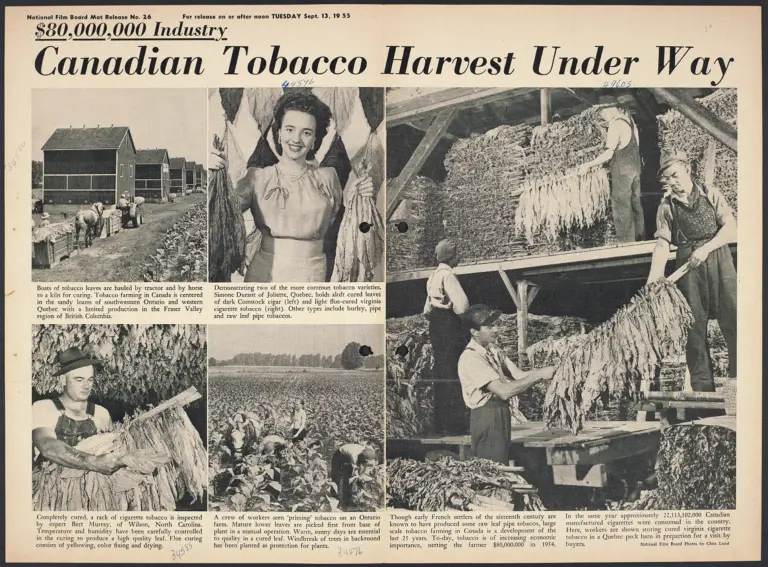
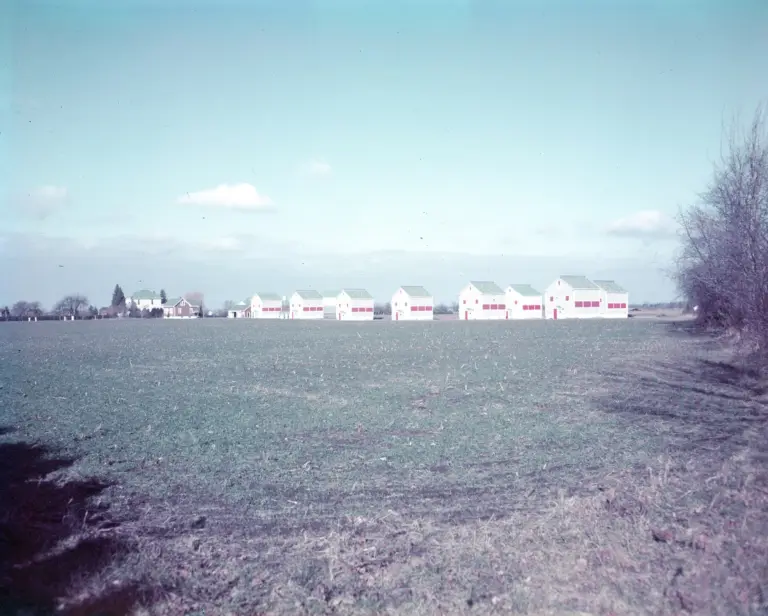
A harvest crew divided the work between them. A 1955 newspaper account counts the crew it took to fill one kiln: six primers, six sorters and tiers, a stoneboat driver and a racker.S35 The filled laths then went into the kiln for a cure of about a week; our guide to the tobacco kilns explains how that worked.S35
Worked down the rows by hand, snapping off the ripe bottom leaves two or three at a time, over several passes.S37
Drove the horse-drawn “tobacco boat” that carried the leaf out of the field.S37
At the tying table, bound bunches of leaf onto laths, sticks about four feet long, ready for the kiln.S35
Remembering the harvest
The NFB’s post drew memories from people who had worked the harvest. One former worker recalled four summers moving from boat driver to primer, tier and suckering, and earning about $450 in five weeks, which paid for school. Another remembered kilns fired with wood and coal, later switched to oil and gas, and Delhi’s park full of people. Others wrote of a Hungarian immigrant mother and uncle who worked the harvest for years, and of schoolmates from Dartmouth, Nova Scotia, who went to Delhi to pick tobacco from 1966 to 1968.S30
“$14 per day plus room and board”
Not every summer looked like the film. In August 1966 a Toronto Star photograph showed harvest workers keeping warm by a fire on a bare field at Delhi, where a creek served for bathing and shaving. Its caption called the place “Delhi’s camp misery”.S32 Chapter 9 tells the larger story of the harvest workforce, from the “transients” to the seasonal workers who came from abroad.
More guides
 GuideThe walking tourEleven stops at the halls, churches and museum
 GuideThe tobacco kilnsHow a cure worked, and the kiln you can visit
 GuideThe harvest workersSoldiers, students, “transients” and workers from abroad
 GuideFeeding the harvestThree meals a day for two dozen, from a Delhi kitchen
 GuideThe Harvest FestivalFrom the 1956 Tobacco Queen to the 2000s
 GuideBlue mould, 1979The epidemic that took a third of the crop
Were you there?
Primed, tied, drove the boat or ran a kiln? Photos, letters and memories of the harvest help us tell it properly. Nothing is published without your permission.