

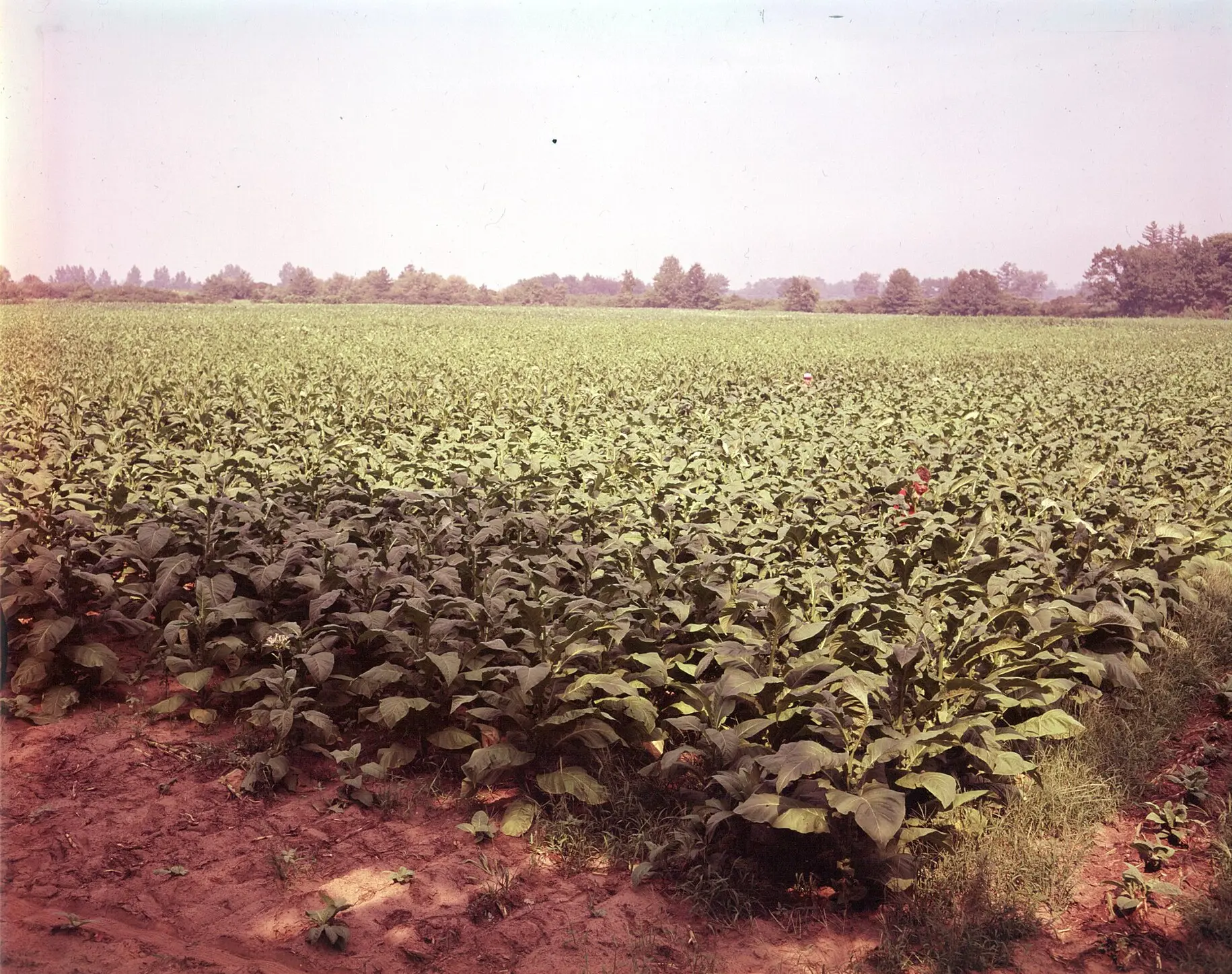
The summer the leaves turned grey Blue mould, 1979
In the summer of 1979 a fungus swept the tobacco belt and destroyed close to a third of Ontario’s crop by the federal estimate. How it was found, why it spread so fast around Delhi, what it cost, and why its origin is still argued over.
Twelve days in July
Blue mould, a downy mildew of tobacco, had not been recorded in Ontario from 1966 to 1978. On 12 July 1979 it was found in a field 3.2 kilometres east of Tillsonburg, in Oxford County, on plants grown from container seedlings imported from Florida, and on the same day in the same field on plants from the grower’s own greenhouse. So writes S. K. Gayed, a scientist at the Delhi research station, in his 1985 study of the epidemic.S68
It moved fast. By 20 July it had been reported on five more farms in Haldimand-Norfolk, again on plants raised from Florida seedlings; by the end of July it was on hundreds of farms in the main tobacco area, and by the end of August Gayed’s count had reached 1,744 farms across the tobacco counties.S68
Growers saw yellow spots 12 to 20 millimetres across on the upper side of the lower leaves, with a greyish-blue downy growth beneath. By August the tip leaves were twisting and puckering, and plants with the infection in their stems were weakened until the wind or the weight of their own leaves toppled them.S68
A belt made for a fungus
Delhi sat at the centre of the outbreak because it sat at the centre of the crop. About 82 percent of Ontario’s flue-cured tobacco in 1979 grew within 50 kilometres of Delhi. Three farms in four grew a single cultivar, Virginia 115, and most of the rest grew Delhi 76; both were susceptible, and the mould grew especially thickly on Delhi 76’s larger leaves. Gayed counts that concentration of susceptible plants among the causes of the epidemic.S68
The weather helped it. July brought spells of cool nights and moisture that suited infection, and the cool, cloudy August was, in Gayed’s words, ideal for the disease, with shifting winds carrying spores from field to field. A single square centimetre of infected leaf can produce as many as a million spores.S68 And growers had nothing to stop it: in 1979 no fungicide was registered in Canada to protect tobacco in the field from blue mould.S68
Three estimates, three measures
The sources do not agree on the loss, and they measure different things. Agriculture Canada’s research branch report for 1979 put it at about 31,800,000 kilograms of tobacco, about 30 percent of the whole crop.S69 The federal plant-quarantine summary for the same year said about half the crop was ruined.S70 And a report to a scientific meeting in August 1980, summarized in Plant Disease, called it the worst plague ever to hit tobacco in Ontario: blue mould on 1,500 farms, the entire crop cut down on 460 of them, and a loss of about $100 million.S71
A third of the crop, or half?
About 31.8 million kg, some 30 percent of Ontario’s crop.S69
About half the crop ruined.S70
We use the research branch’s figure, which gives its measure, and quote the others as their authors gave them. We have not found a calculation that reconciles the two.
Florida seedlings, or the wind?
At the time, officials suspected the seedlings. The quarantine summary said the disease was thought to have entered Canada on tobacco plants imported from Florida in June 1979, and the 1980 meeting report linked the outbreak to seedlings imported from Florida too.S70S71
Gayed, writing six years later from Delhi, argued against that. Infected seedlings usually show early, systemic infections, he pointed out, but in 1979 the systemic infections appeared only on mature plants. And when Environment Canada traced the air currents backwards, it suggested that spores from Virginia had reached Ontario’s main tobacco area on 29 and 30 June 1979.S68 His case is an argument, not a proof. We tell it as a disagreement that has not been settled.
A fungicide, a ban, a committee
The response came within the year. The fungicide Ridomil was registered temporarily for use against the disease, any crop found infected in 1980 was to be ploughed down, imports of tobacco plants into Canada were prohibited from every country, and Ontario joined a blue mould warning committee based in North Carolina to track outbreaks.S70 These were the measures of 1979 and 1980, not advice for today.
The epidemic did not come back. In 1980 there was no trace of blue mould in the main tobacco area, where growers sprayed their crops, and only a few cases near Mount Brydges and in Northumberland County; there was one farm near Straffordville in 1981, three near Silver Hill in 1983, and none at all in 1982 and 1984.S68 For the growers’ board, the lesson was insurance: Andy Zei’s Hall of Fame biography recalls blue mould devastating the crop in his first year as a director, and crop insurance becoming a key issue.S59

More guides
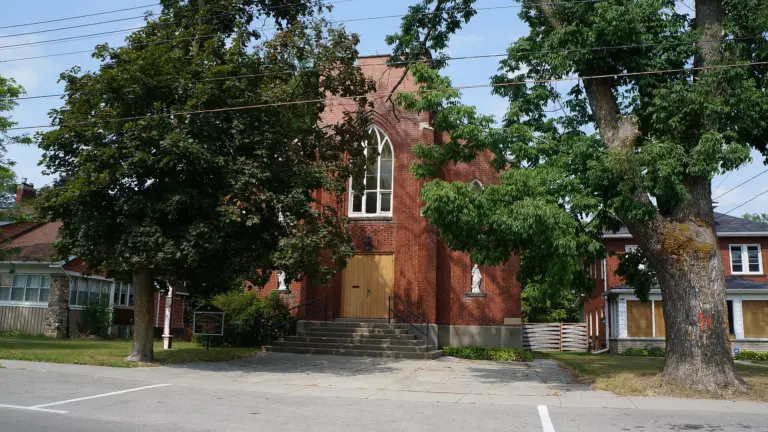 GuideThe walking tourEleven stops at the halls, churches and museum
 GuideThe tobacco kilnsHow a cure worked, and the kiln you can visit
 GuideThe harvest workersSoldiers, students, “transients” and workers from abroad
 GuideFeeding the harvestThree meals a day for two dozen, from a Delhi kitchen
 GuideThe Harvest FestivalFrom the 1956 Tobacco Queen to the 2000s
 FilmThe Back-Breaking LeafThe NFB’s 1959 film of the harvest
Remember 1979?
Did your family lose a crop to blue mould? Photos, a cheque stub, a memory of cutting the fields: help us tell it from the farms. Nothing is published without your permission.