The buildings that say tobacco country The tobacco kilns
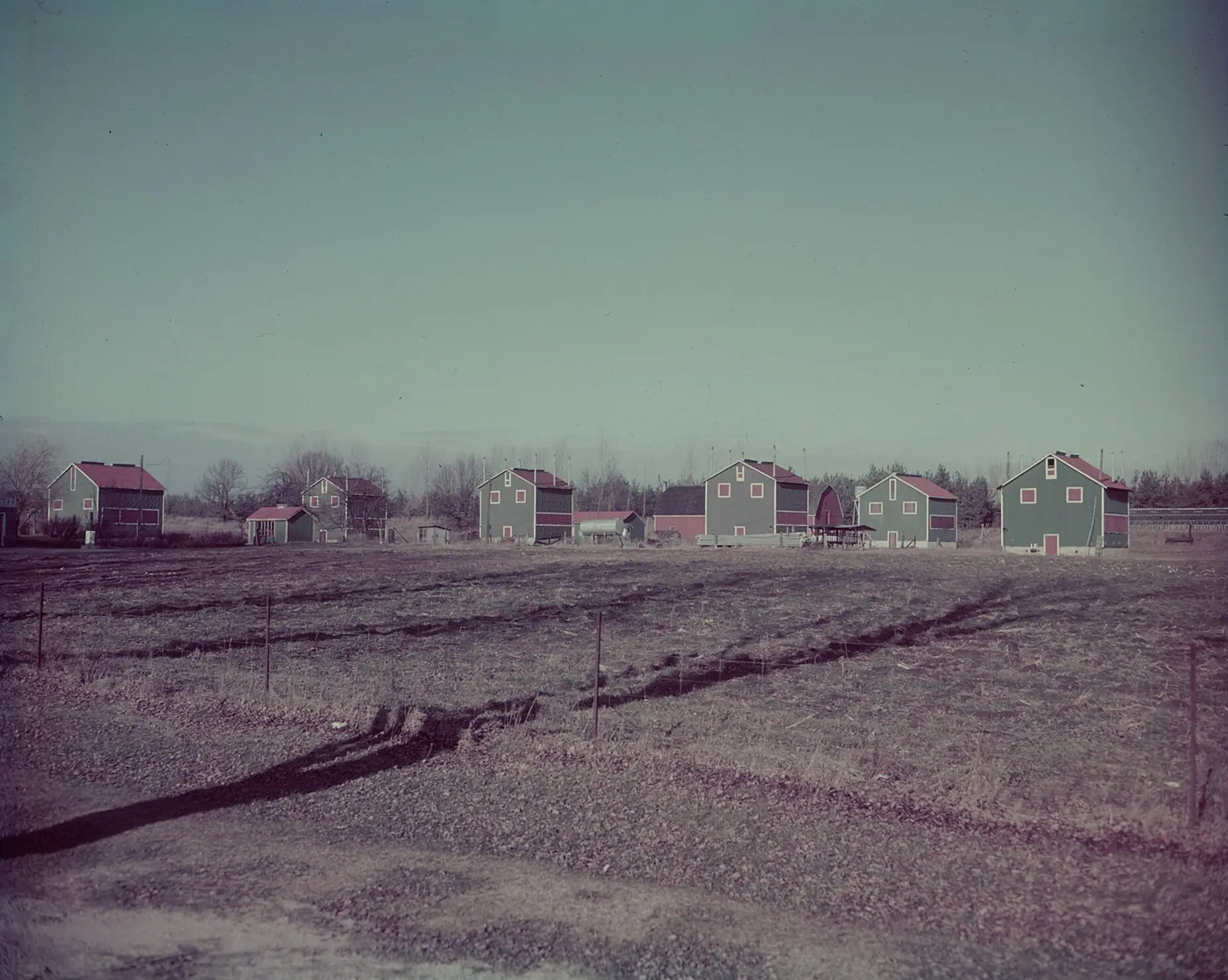
Tall, square and nearly windowless, curing kilns still stand along the back roads of Norfolk County. What they were for, how they worked, how they changed, and how to see them without trespassing.
One building, one job
A is where green tobacco leaf became the golden leaf that buyers paid for. Flue-cured tobacco takes its name from the method: ducts, or flues, carry heat from furnaces through a closed building.S50 Burley and other types were dried differently, in open, ventilated barns without added heat.
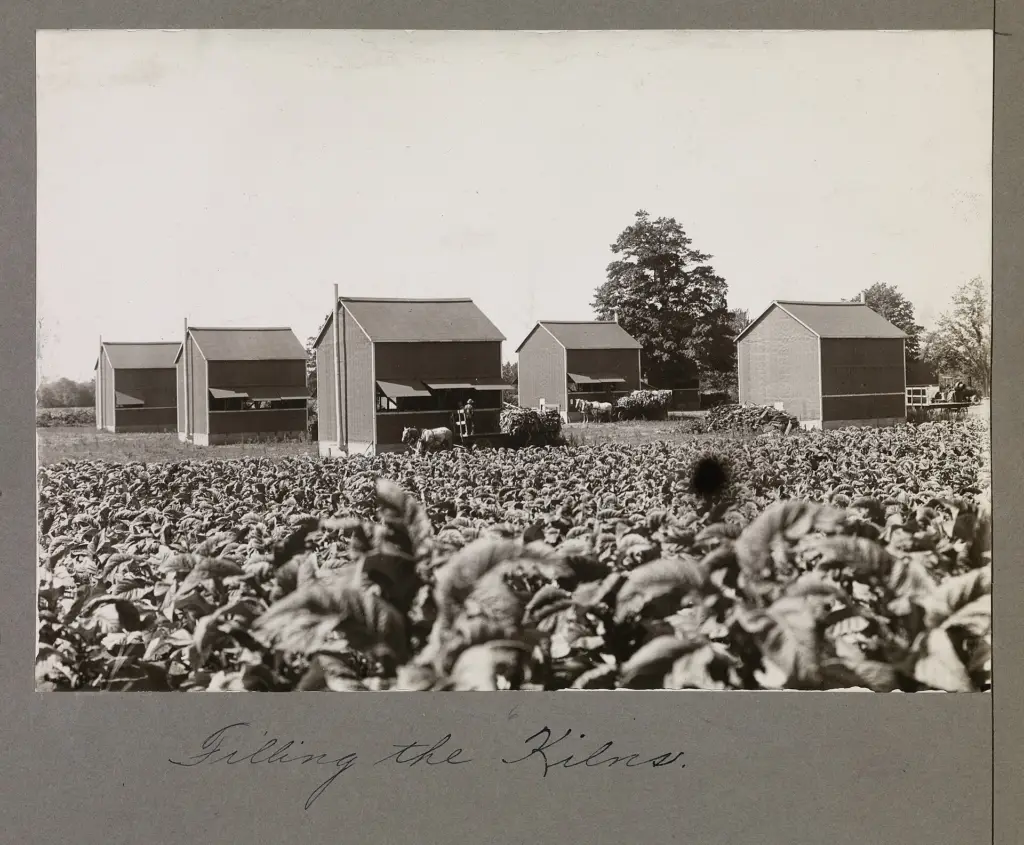
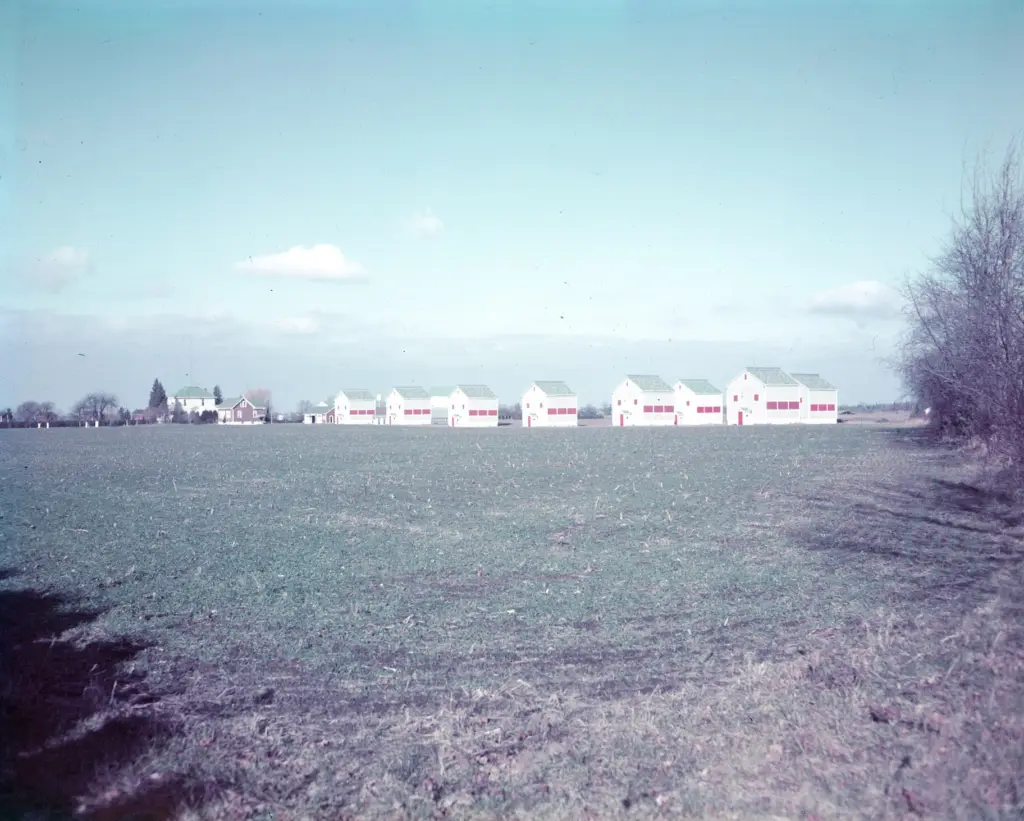
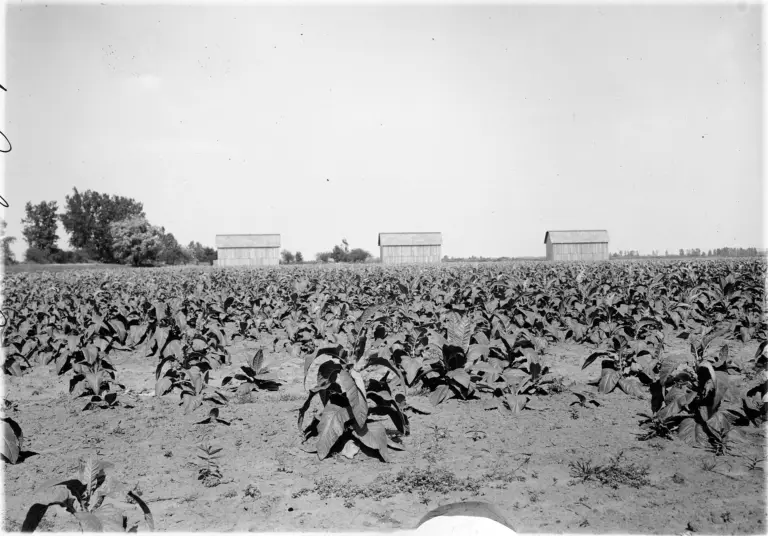
A flue-cured farm needed more than one: farms generally had a kiln for every five or six acres of crop, filling, emptying and refilling them in rotation through the harvest, the historian Edward Dunsworth writes.S64 When the federal tobacco substation opened west of Delhi in 1933, its first buildings were a two-storey and three curing kilns, and more kilns followed in 1939 and 1940.S1 Repeat that across the farms of the sand plain and you get the landscape the district is known for: rows of tall, square buildings at the edge of the fields.
Many were built from local wood. In the 1930s the Quance mills in Delhi cut lumber for kilns, laths and barns.S33
- Shape
- Tall, square and plain, with a simple profileS51
- Walls
- A wooden frame and beams inside, shiplap boards outsideS51
- Low down
- The furnace door and other openingsS51
- On the roof
- Ventilators along the ridge, and a stack for the furnaceS1
- At the door
- On some, a small entry vestibuleS1
From green to gold
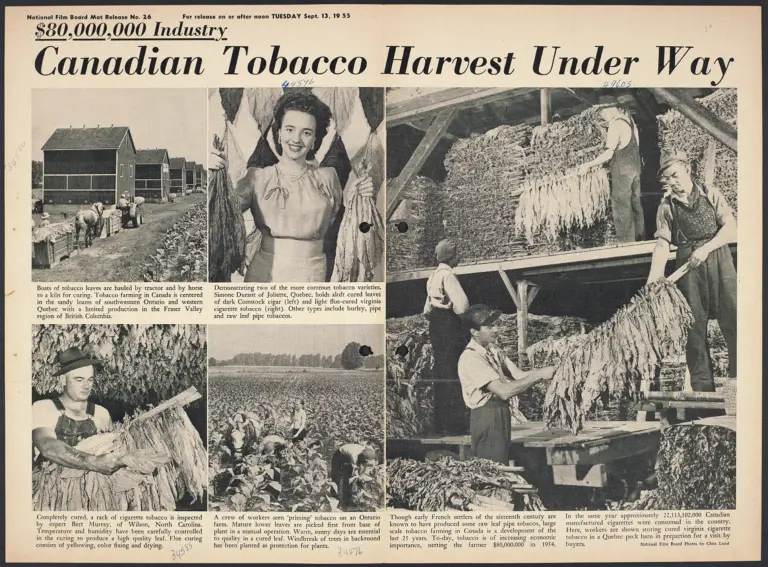
At harvest, from about the second week of August into early October, picked the ripe leaves a few at a time, and tied them in bunches onto , sticks about four feet long.S37S35 The laths were hung in rows inside the kiln.
The Delhi station’s first kilns, built in 1933, each held 900 to 950 laths, or 80,000 to 95,000 leaves. Two coal-burning furnaces fed a system of flue pipes that ran back and forth near the floor, below the tobacco, then joined at the centre rear and left through a stack above the roof.S1
A 1955 newspaper account put a whole cure at about a week, with the heat raised gradually from 90°F to 170°F.S35 It was a skilled job. The Elgin County Archives record that from the tobacco belt of the southern United States once came north to oversee curing, until local farmers learned to do it themselves.S50 In 1936, 850 curers came to Ontario from the American South, many of them to Norfolk, and in 1933 a curer could make $25 to $35 a week, when a field hand made one or two dollars a day.S3
A cure ran in stages, and every one could go wrong. The Elgin County Archives’ account of flue-curing describes them like this:S50
For 20 to 40 hours the leaf is kept warm and humid until it turns yellow. Too much heat or too little humidity leaves it green; too long, and it dies.S50
Over two to four days the heat goes up to dry the leaf, and last of all the stems. Heat raised too fast scalds the leaf brown.S50
The kiln cools and the doors are opened, so the damp night air softens the leaf. Then it goes to the pack barn, and the kiln is filled again.S50
Coal, oil and forced air
The kiln was never a finished design. Before 1933 much of the flue-cured crop was stalk-cut for curing; the Delhi station’s kilns were built for primed leaf instead.S1 The fuel changed too. Older furnaces burned coal or wood; newer ones ran on oil or natural gas.S50 Wood was cheap in the 1930s, and the kilns ate woodlots: a provincial forester estimated that Norfolk’s tobacco farmers burned some 40,000 cords in them, undoing much of the county’s reforestation.S3
The station tried forced-air curing in a small experimental kiln in the 1940s, and from 1954 to 1956 studied it in earnest with the tobacco companies and the Ontario Research Foundation. Its studies showed the value of ridge ventilators, indirect bottom ventilators, vestibule entrances and insulation, for easier curing and for fire prevention, and it published bulletins on kiln construction.S1
Ontario went on to develop low-profile kilns with low-volume, downdraft forced-air systems.S1 Then came the biggest change. In 1961 the station bought a commercial from the United States to test, the first in Canada. In bulk curing, densely packed leaves are held in place by spikes and cured with high-volume forced air, with no tying onto laths.S1
Fire was the old danger. In the 1940s insurance companies reported Ontario kiln-fire losses as high as half a million dollars a year, and the Delhi station called uneven drying the chief weakness of every curing system then in use.S77 Kilns kept working, and kept being refitted, into this century. After several kiln fires in the 2005 curing season, in kilns retrofitted with heat exchangers, Ontario’s Technical Standards and Safety Authority advised growers to have the whole kiln, heat exchanger, burner and safety controls inspected by a certified gas technician before each season.S54
Kilns on the land
“Scattered across Norfolk County are tobacco kilns, remnants of a once vibrant industry,” as Norfolk Heritage & Culture put it in 2024, when the Delhi Tobacco Museum showed Larry Monczka’s photographs of them.S52 Monczka and Amber Homeniuk had published a book of his kiln photographs, taken over seven years, in 2018.S53
Some kilns have been taken down. The research station itself removed several old kilns from a farm it bought, while one of its three 1933 kilns was still in use in 1983, with a modern curing system.S1 Others have been moved, reused or left to the weather. The oldest we know of on paper, the kiln Henry Freeman and William Pelton built at Lynedoch in 1923, is one we are still trying to trace.S22
The kiln you can visit
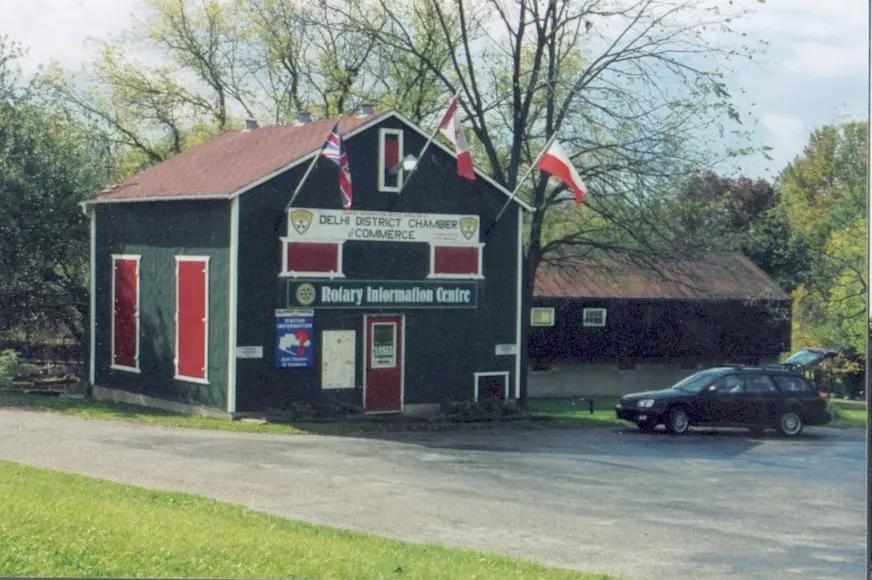
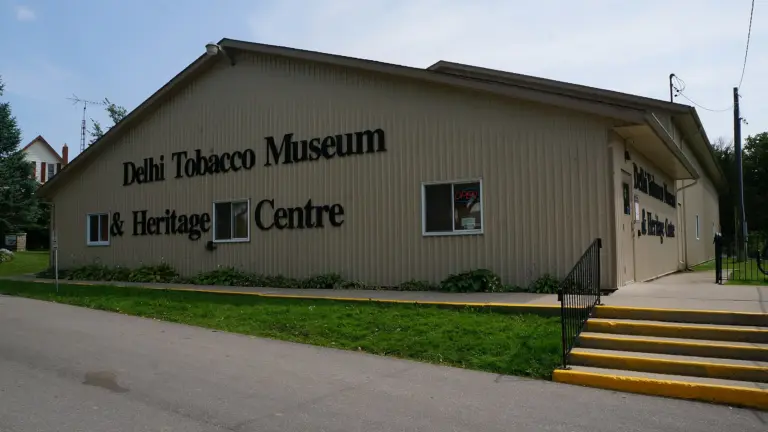
One kiln is protected by law. In 2017 Norfolk County designated the tobacco kiln at the Delhi Tobacco Museum & Heritage Centre under the Ontario Heritage Act (By-law 2017-73), as a landmark of the county’s flue-cured tobacco industry.S51 Oscar and Godelieve Lava donated it from their farm in South Norwich Township, Oxford County, and it was moved to Delhi in 1982 to serve as a tourist information centre.S51
The designation protects its simple square form and heritage colours, the placement of its openings, furnace door included, its interior wood frame and beams, and its shiplap siding.S51 Stick-hung tobacco still hangs inside.S6 It stands beside the museum, above Quance Park; check the museum’s hours before you go.
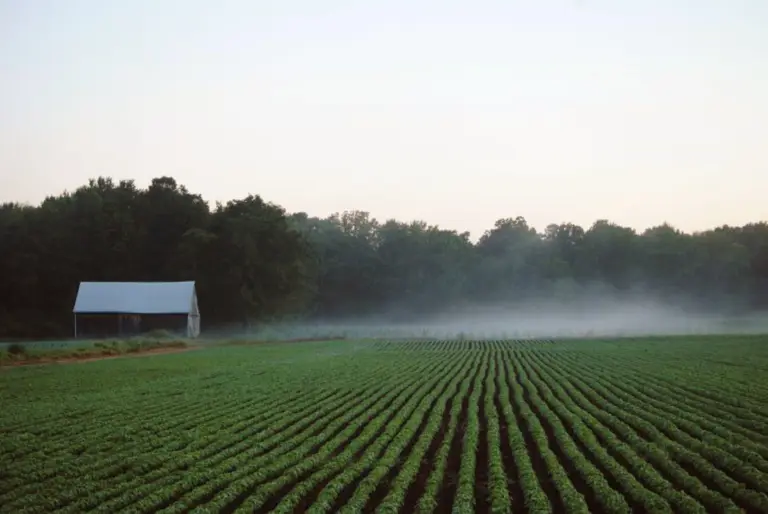
Almost every kiln in Norfolk County is on private land. Enjoy them from the public road, don’t go in or onto the farm without the owner’s permission, and remember that old kilns can be unsafe. This site shows farm kilns by general area only, never an address.
 Today
Kilns in the story
More guides
 GuideThe walking tourEleven stops at the halls, churches and museum
 GuideThe harvest workersSoldiers, students, “transients” and workers from abroad
 GuideFeeding the harvestThree meals a day for two dozen, from a Delhi kitchen
 GuideThe Harvest FestivalFrom the 1956 Tobacco Queen to the 2000s
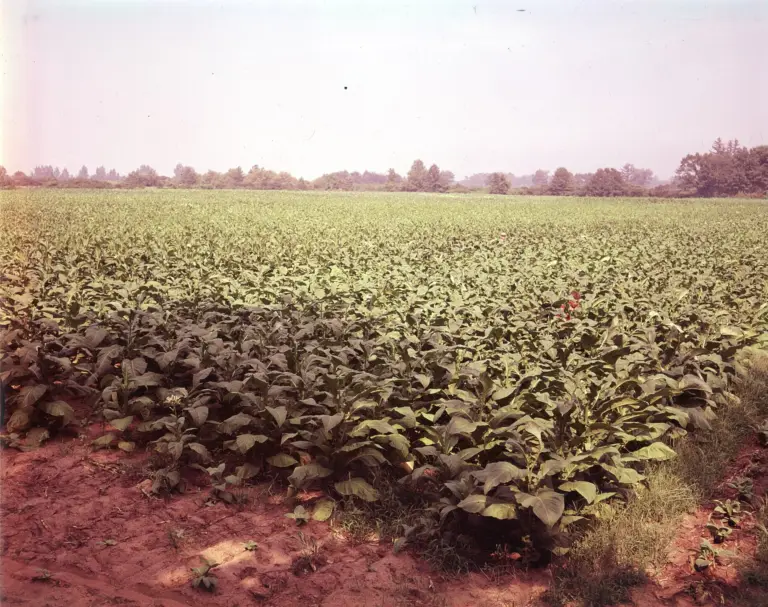 GuideBlue mould, 1979The epidemic that took a third of the crop
 FilmThe Back-Breaking LeafThe NFB’s 1959 film of the harvest
Know a kiln?
A kiln your family built, a cure that went wrong, a photo of the furnace. Tell us what you know; we never publish a farm’s location without the owner’s permission.