Halls built in the tobacco years
The communities tobacco drew to Delhi built clubs, churches and halls, and some still stand. Each has its own history, and each deserves more than a line in a “multicultural” paragraph.
A town of halls
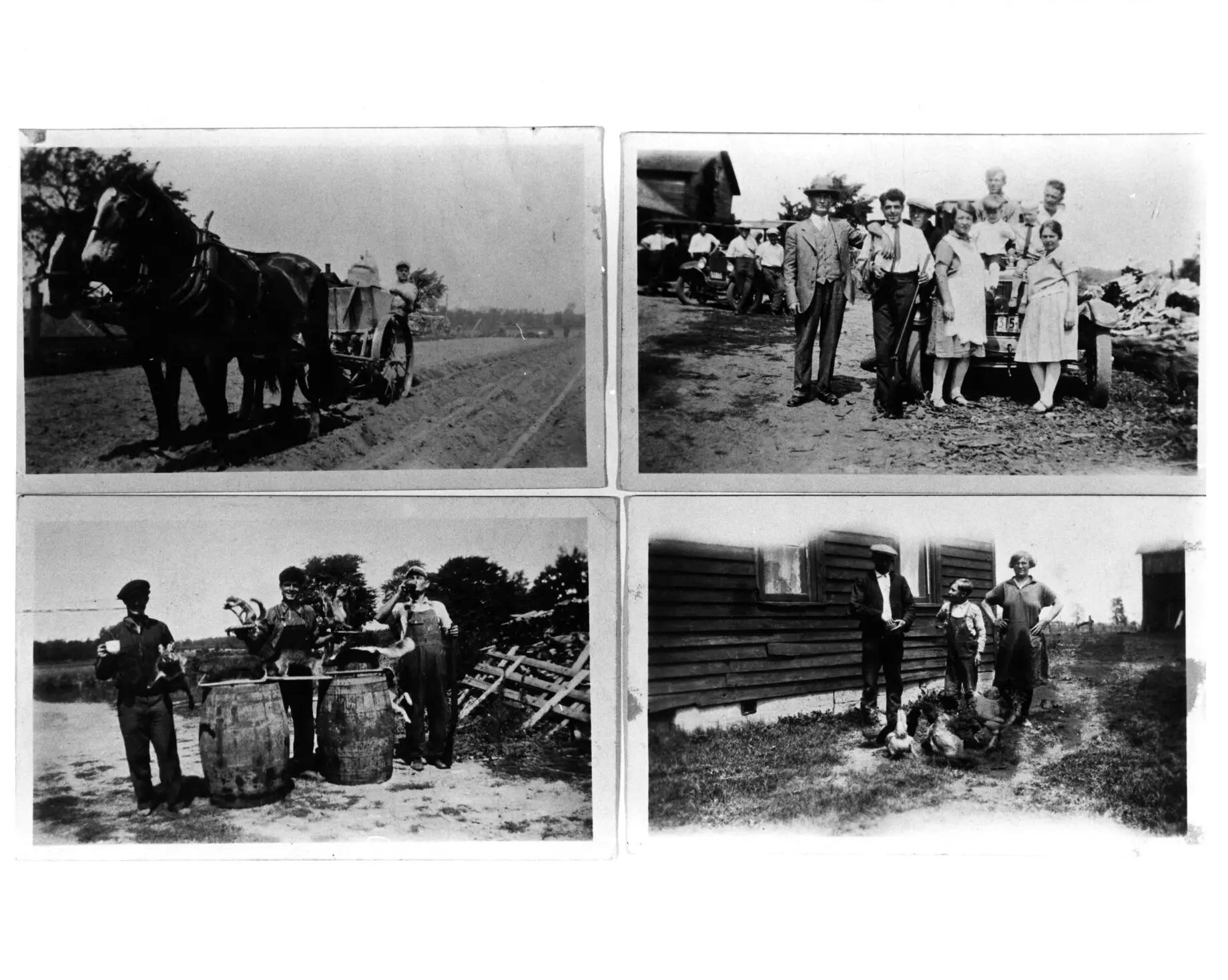
In 1951 Maclean’s sent a writer to Delhi. He found a town of about 2,500 where, he wrote, three in four people were Europeans who had “fled Communism, Nazism or poverty at home,” and where you could hear eight languages on the street.1
The national halls were the heart of it. Each cost about $80,000, raised by forming companies and selling shares, borrowing from a bank and running fund drives, and “every night there’s a dance, social or wedding in one or more halls.”1
The Hungarian House
By the House’s own account, Hungarians in the district began organizing a hall in January 1947, led by Paul Rapai, and formally founded the Tobacco District Hungarian House that February. It was dedicated on 15 May 1949, the community’s first completed project.2
It hosted national celebrations, formal balls, shows, dancing classes and chess tournaments. Rapai, its first president, also sponsored 338 Hungarian displaced persons after the war.2 More of its story is on the Hungarian community page.
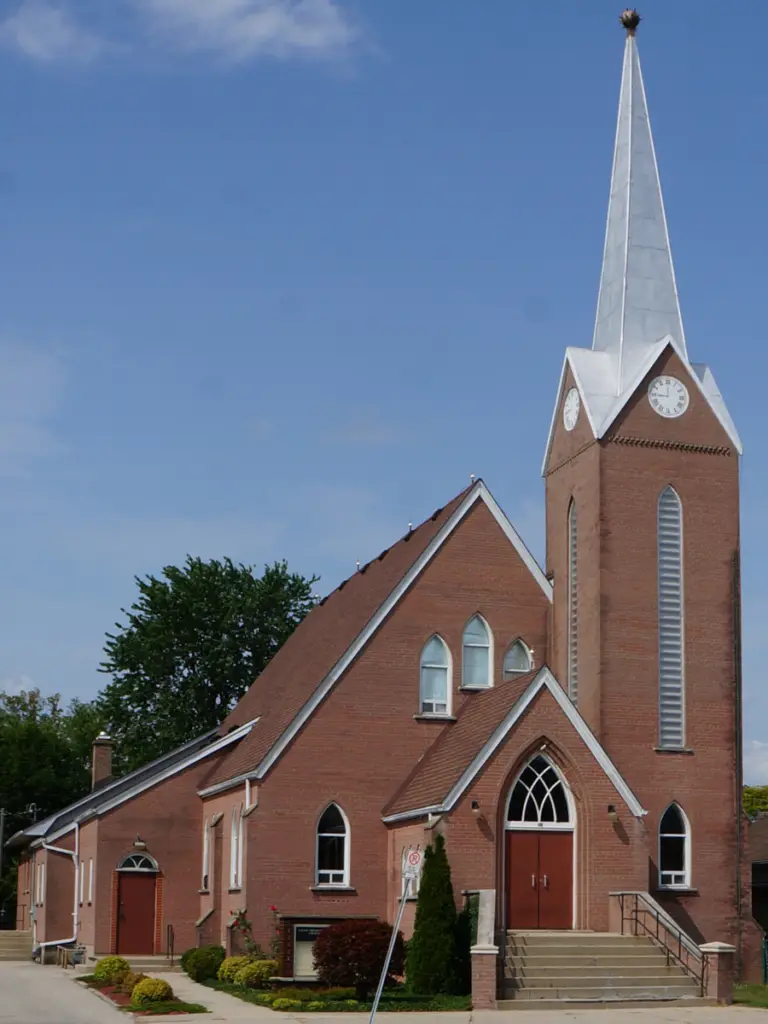
The community had its own church as well. The Calvin Presbyterian Church served Delhi’s Hungarians from 1951 to 2017, the Delhi Tobacco Museum’s Building History series records.3
The congregation was founded on 29 March 1948 and met at first on Sunday afternoons in the First Baptist Church. Its cornerstone was laid in 1950, and the church on Lansdowne Street, built in the style of the churches its members had known in Hungary and Romania, opened on 22 July 1951. It took the name Calvin Presbyterian in 1961.4
 Today
The Belgian Club
According to the club’s own history, Delhi’s Belgians formed a dramatic club in 1943, led by Gerard VandenBussche, to raise money during the war. Shares sold at $100 each paid for a hall, which opened in 1948.5
For nearly seventy years the club ran archery, feather bowling, pigeon racing and card clubs, and the hall was part of southwestern Ontario’s music scene. It closed in 2017, and the property was sold in December 2018.5
The German Home
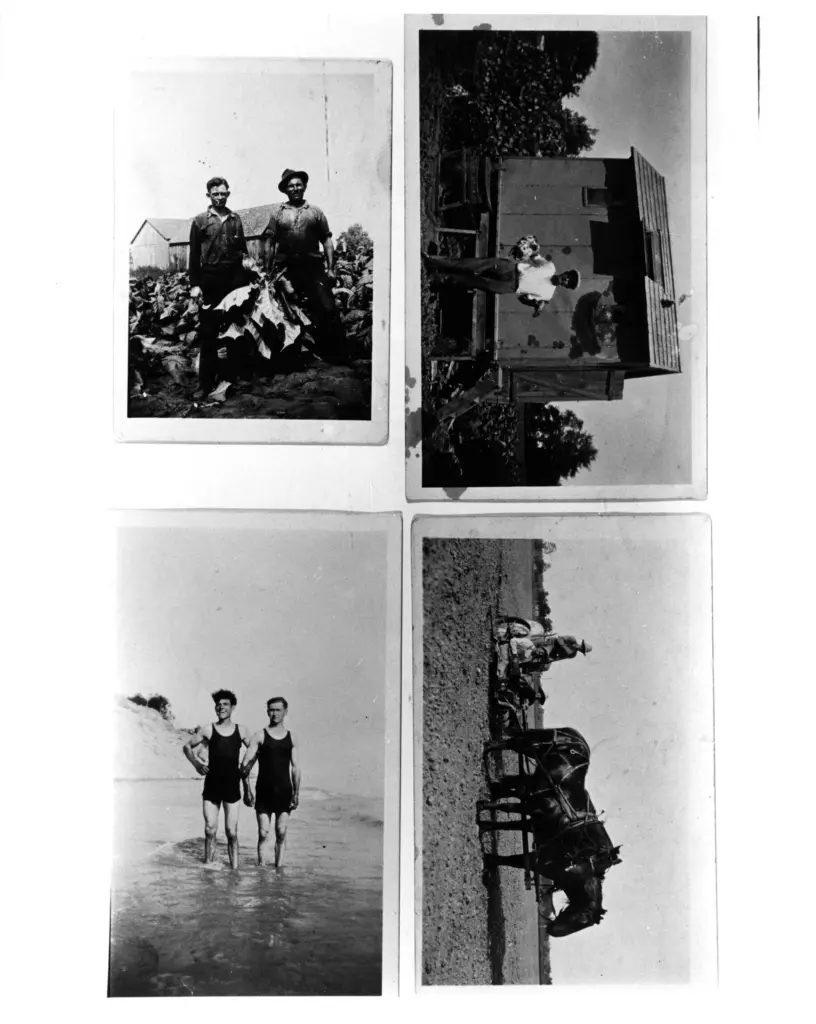
A historical marker at the German Home tells its story. Saxons came in the 1920s and 1930s, many drawn by the newly developed tobacco farming around Delhi; Swabians followed after the Second World War. The German Association Club of Delhi was founded on 20 April 1936 and held its dances in other halls around town.6
The marker records that the German Home was built in 1949, and that its first dance was held on 25 November 1950.6
It was built from the Hungarian House’s blueprints: a hall 150 feet by 50, on seven lots bought from William E. Adams, meant to keep up the traditions of ethnic Germans and to give the community a club.4 In 1951 Maclean’s found bowling alleys, billiard tables, a big main hall and a room for the children.1
The Lithuanians
According to the Lithuanian Canadian Community’s history, Lithuanians were on Delhi-area tobacco farms by 1930–31, and about a hundred families and individuals lived around Delhi by the Second World War.7
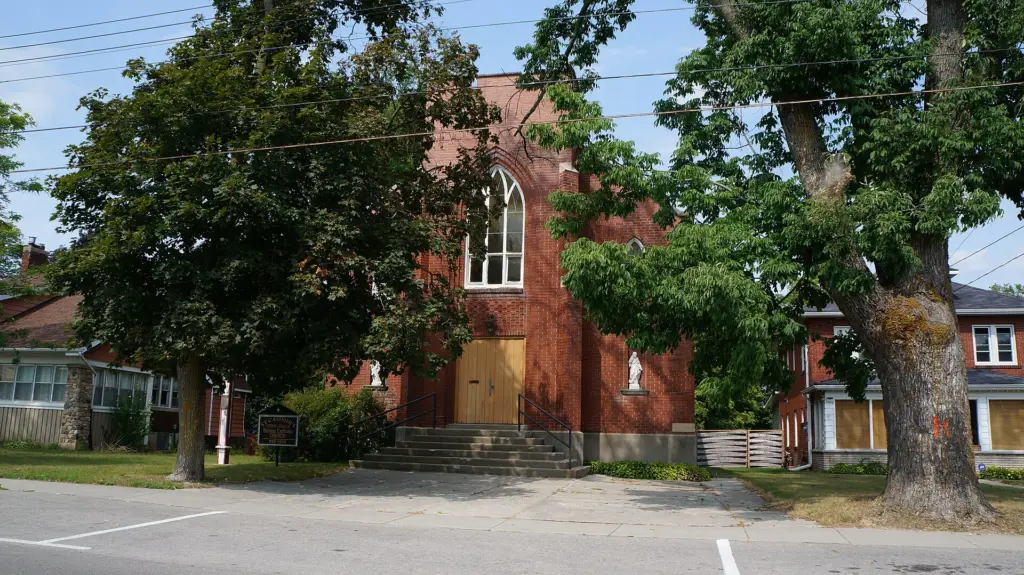
Their parish came later. St. Casimir’s Lithuanian Church was formed in 1959 on Talbot Street, on the former site of the St. John de Brebeuf church, and served Lithuanians from as far as Ingersoll, Woodstock, Port Burwell and Aylmer. The 18-foot oak cross in front went up in the early 1970s.4
 Today
The Polish Alliance
A small group of Poles in the Delhi area joined the Polish Alliance of Canada as its Branch 17 on 14 December 1939. In 1942 the branch bought a lot on Main Street, and its hall opened on 20 April 1947. The museum’s walking tour records that the branch still works to keep the language and traditions alive.4 Maclean’s listed the Polish Hall among the town’s dance halls in 1951.1 More is on the Polish community page.
Ukrainians, Slovaks and Portuguese
Not every hall was purpose-built. In 1944 a portable classroom from the Delhi Public School was moved to the corner of Maple and Imperial streets and opened on 11 June as the “New Greek Ukrainian Hall.” By about 1950 it was the Slovak Recreation Club, and in 1962 the Odd Fellows and Rebekahs bought it. The little building now stands at the McLaughlin soccer field at the south end of Main Street.4 See the Ukrainian community page.
Later arrivals built too. In 1978 Mario DaSilva bought a former grocery store at Main and Gilbert streets as a Portuguese Hall, a place to keep up the language and culture. As membership fell it was sold to the Knights of Columbus in 1987.4 Chapter 7 and the Portuguese community page tell how Portuguese families came to the tobacco farms.
In 1978, too, volunteers led by the Rev. László Pándy-Szekeres founded the Multicultural Heritage Association of Norfolk, to promote cultural awareness through Heritage Days and much else.4 Its fortieth-anniversary marker, on Main Street in front of the library, calls Delhi the “Hospitality Capital of Canada.”8
And many more
Maclean’s in 1951 also met Latvian families and a Dutch grocer.1 Many more communities appear in the Delhi Tobacco Project’s oral histories.9 Their stories are still being researched for this site. If your family is one of them, we’d love to hear from you.
Photos wantedThe halls, any decadeOpenings, dances, weddings and programmes from any of Delhi’s halls.Share a photo →